- All
- Product Name
- Product Keyword
- Product Model
- Product Summary
- Product Description
- Multi Field Search
Views: 0 Author: Site Editor Publish Time: 2025-10-11 Origin: Site


Ever wondered how ships stay anchored in turbulent waters? The secret lies in the anchor chain. This vital component ensures a vessel remains secure. Understanding anchor chain size is crucial for safety and performance. In this post, you'll learn the importance of measuring anchor chain size and explore various methods to do it accurately.
When measuring an anchor chain, understanding its key dimensions is crucial. These dimensions affect how the chain fits your windlass and how well it performs in anchoring your vessel. Here are the main measurements to focus on:
This is the thickness of the metal wire used to form each chain link. It’s the primary size people refer to when talking about anchor chains. Measuring the wire diameter accurately ensures you get the right strength and compatibility with your equipment. Use calipers to measure the wire diameter away from the welds for the most precise reading.
Link length refers to the total length of a single chain link from one end to the other, measured along the chain’s length. However, when matching chain to a windlass gypsy, the more important measurement is the pitch.
This is the measurement across the widest part of a link, perpendicular to the link length. While not always critical, link width can affect how the chain fits in certain windlasses or chain lockers.
Pitch is the inside length of a link, measured from the inside edge of one end to the inside edge of the other. It's vital for ensuring the chain fits snugly into the gypsy's pockets. Measuring pitch over multiple links (usually 5 or 10) and averaging the result helps account for any irregularities.
● Avoid measuring at welds. The weld area can be thicker or thinner than the wire diameter.
● Measure several links randomly, not adjacent ones, to get a representative average.
● Clean off any rust, coatings, or crusts before measuring to avoid inaccurate results.
● For older chains, watch for wear or deformation, which can skew measurements.
Understanding these dimensions helps ensure you select or replace your anchor chain correctly, avoiding issues like chain slipping or damage to your windlass. Always double-check measurements and consider consulting chain dimension tables based on standards like DIN766 or ISO4565 to confirm your findings.
Measuring your anchor chain size accurately is key to ensuring it fits your windlass and performs safely. There are several methods you can use, depending on the tools you have and the condition of your chain. Here's a detailed guide on how to measure your chain size effectively.
Calipers are the best tool for precise measurements. They allow you to measure the wire diameter and pitch with high accuracy. To use calipers:
● Select several random links, avoiding adjacent ones to get a true average.
● Measure the wire diameter away from the welds, as welds can be thicker or thinner.
● For pitch, measure the inner length of a link or better, measure over multiple links (such as 5 or 10) and divide by the number of links to get an average.
● Clean any rust or coatings before measuring to avoid errors.
Calipers provide measurements down to fractions of a millimeter, which is crucial for matching chains to windlass gypsies.
If you don't have calipers, a tape measure or ruler can still work but with less precision. Here's how:
● Lay the chain flat and pull it tight.
● Measure the wire diameter by holding the tape or ruler against the side of a link.
● Measure the pitch by measuring the length over several links (e.g., 5 or 10) from outside edge to outside edge, then divide by the number of links.
● Take multiple measurements on different parts of the chain to average out inconsistencies.
This method is less accurate but often sufficient for general purposes or when the exact calibration isn't critical.
Older chains may have wear, corrosion, or deformation that affects measurements. Keep these points in mind:
● Worn links can be thinner or misshapen. Avoid measuring links with obvious wear.
● Corrosion or crusts can increase apparent size. Scrape off buildup before measuring.
● Chains may stretch slightly over time, affecting pitch measurements.
● Take several measurements and note variations to estimate true size.
If the chain is heavily worn or damaged, it’s safer to replace it rather than rely on measurements for sizing.
Tip: When measuring your anchor chain, always measure multiple links randomly and avoid welds or worn areas to get the most accurate average size.
When selecting an anchor chain, understanding calibrated chains is essential. Calibrated chains are manufactured to specific dimensions, ensuring they fit perfectly with your windlass gypsy and perform reliably.
A calibrated chain is made to precise standards for wire diameter, pitch (inner length), and link width. These exact measurements ensure the chain links fit snugly into the pockets of the windlass gypsy, preventing slippage or damage. Unlike generic chains, calibrated chains maintain consistent sizing, which is critical for safe and efficient anchoring.
The windlass gypsy, or wildcat, is the sprocket that grips the anchor chain during deployment and retrieval. If the chain isn't calibrated correctly, it can slip, jump, or cause excessive wear on the windlass. This can lead to costly repairs or even dangerous situations while anchoring. Calibration ensures the chain matches the gypsy's design tolerances, providing smooth operation and extending equipment life.
Two widely recognized standards govern calibrated anchor chains:
● DIN766: A German standard specifying chain dimensions for various diameters. Chains made to DIN766 have tight tolerances for wire diameter, pitch, and link width. This standard is common in Europe and many other regions.
● ISO4565: An international standard similar to DIN766 but with slight variations in pitch and link dimensions. ISO4565 chains are often used in global shipping and marine industries.
Both standards allow small tolerances to accommodate manufacturing variations. When measuring your chain, compare your results against these standards to identify the correct calibration.
Because the pitch is measured over multiple links, a common method is to lay out ten links flat and pull them tight. Measure the total length from the outside edge of the first link to the outside edge of the tenth. This measurement helps determine the chain's pitch and, combined with wire diameter, confirms the calibration.
● Older chains may have slight wear or corrosion affecting measurements. This can make the chain appear slightly larger or longer than new calibrated chains.
● Chains that fall between two calibrations might be from different standards or regional specifications, such as US-made chains.
● Gypsys usually tolerate small variations, typically up to 2%, but exceeding this can cause operational issues.
If unsure, obtaining sample chains for trial fitting in your windlass gypsy is a wise step before purchasing large quantities.
Selecting the right anchor chain size depends on several key factors. These factors ensure the chain can safely hold your vessel in place under various conditions. Let’s dive into the main considerations:
The size and weight of your vessel play a huge role in choosing the anchor chain diameter. Larger vessels have more surface area exposed to wind and water forces, creating greater strain on the chain. For example:
● A small recreational boat might only need a 10mm or 12mm chain.
● Medium to large commercial vessels often require chains of 48mm or more.
● Very large ships, like tankers or container ships, use chains up to 90mm in diameter.
The vessel's displacement (weight of water it pushes aside) also matters. Heavier vessels exert more force on the anchor chain, so thicker, stronger chains are necessary to prevent failure.
The holding power needed depends on the vessel's environment and anchoring conditions. Chains must resist dragging caused by wind, waves, and currents. Consider:
● Weather patterns: Areas with frequent storms or strong winds require thicker chains.
● Seabed type: Soft bottoms like mud or sand need longer, heavier chains for better grip.
● Mooring duration: Longer stays in one spot may demand more robust chains to ensure safety.
A thicker chain provides higher holding power, reducing the risk of anchor dragging during rough conditions.
Material quality impacts chain performance and lifespan. Common materials include:
● High-tensile steel: Offers excellent strength-to-weight ratio. Chains are strong yet lighter, easing handling.
● Galvanized steel: Coated to resist rust and corrosion, ideal for harsh marine environments.
● Stainless steel: Highly corrosion-resistant but more expensive, used in specialized applications.
Choosing corrosion-resistant materials extends chain life and maintains strength, especially in saltwater. It also reduces maintenance and replacement costs.
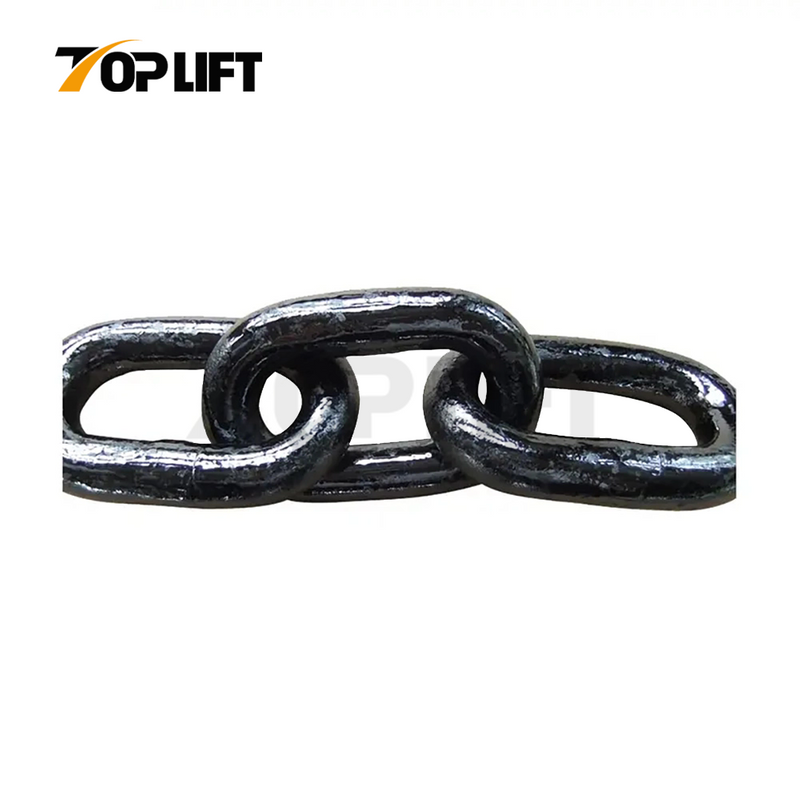
Choosing the right anchor chain diameter is crucial for your vessel's safety and performance. The diameter depends on your vessel's displacement, the environment, and the forces the chain must withstand. Here's a simple step-by-step guide to calculate the minimum anchor chain diameter you need.
Displacement is the weight of water your vessel pushes aside when floating, usually measured in metric tons (tonnes). It reflects your vessel's actual weight and load. You can find this figure in your vessel's specifications or calculate it by multiplying length, beam, draft, and a block coefficient, then converting to tonnes.
For example, if your vessel displaces 20 tonnes, that’s the number you'll use in the next step.
The chain size multiplier is a factor applied to your vessel's displacement to estimate the required chain diameter. Industry standards often suggest a multiplier between 1/8 (0.125) and 1/6 (0.167), depending on vessel size, anchoring conditions, and safety margins.
● Use 1/8 for calm waters and smaller vessels.
● Use 1/6 for rough conditions or larger vessels needing extra safety.
If your vessel displaces 20 tonnes and you choose a multiplier of 1/6, multiply 20 by 0.167.
Multiply the vessel's displacement by the multiplier to get the minimum chain diameter in millimeters.
Example Calculation:
● Vessel displacement: 20 tonnes
● Chain size multiplier: 1/6 (0.167)
Calculation:20 tonnes × 0.167 = 3.34 mm
Since 3.34 mm is too small for practical marine chains, this number usually corresponds to a factor that helps select an industry-standard chain diameter. Typically, you round up to the nearest standard size, such as 10mm, 12mm, or larger, depending on your vessel type.
● Always check your vessel's exact displacement from official documentation.
● Use a higher multiplier for areas with strong currents, storms, or soft seabeds.
● Consult with professionals or chain manufacturers to confirm your calculations.
● Remember, selecting a chain that's too small risks failure, while one too large may be unnecessarily heavy and expensive.
Anchor chains come in various sizes, each designed to suit different vessel types and anchoring needs. Selecting the right size ensures proper strength, durability, and compatibility with your windlass and gypsy. Here's a breakdown of some common anchor chain sizes you might encounter:
This size is often used for medium-sized commercial vessels or larger recreational boats. It offers good strength for moderate loads and is a popular choice for boats requiring reliable holding power without excessive weight.
Slightly larger than 48mm, this chain size is suitable for vessels needing a bit more strength. It’s common among fishing boats and medium cargo vessels. The extra diameter provides additional durability and resistance to wear.
A mid-range size popular for larger commercial vessels. It provides excellent strength and holding power, suitable for ships exposed to harsher marine conditions. This size balances weight and performance for vessels that anchor frequently.
Used for heavy-duty applications, including large cargo ships and tankers. The 81mm chain offers robust strength and durability, making it ideal for vessels facing strong currents, winds, and rough seas.
This size is common among very large vessels such as oil tankers and container ships. It provides exceptional holding power required for anchoring in deep waters and challenging environments.
One of the largest sizes available, 90mm chains are reserved for supertankers and the largest container ships. These chains deliver unparalleled strength and durability, ensuring safety in extreme marine conditions.
When selecting chain size, consider your vessel's weight, typical anchoring conditions, and windlass compatibility. Larger diameter chains offer greater strength but add weight and cost. Smaller sizes may be easier to handle but might not provide sufficient holding power for bigger vessels.
Chain Size (mm) | Typical Vessel Type | Application |
48 | Medium commercial, large recreational | Moderate holding power |
50 | Fishing boats, medium cargo vessels | Enhanced durability |
73 | Large commercial vessels | Frequent anchoring, rough conditions |
81 | Cargo ships, tankers | Heavy-duty, strong currents |
87 | Oil tankers, container ships | Very large vessels, deep water |
90 | Supertankers, largest container ships | Extreme marine environments |
Understanding anchor chain dimensions is essential for proper fit and performance. Key measurements include wire diameter, link length, width, and pitch. Accurate measurement methods, such as using calipers, ensure precise sizing. Consider vessel size, holding power, and material strength when selecting a chain. For expert guidance, consult professionals or refer to dimension standards. For reliable and durable anchoring solutions, consider products from TOP LIFT. Their offerings are designed to meet various vessel needs, ensuring safety and efficiency.
A: An anchor chain is a series of linked metal rings used to connect an anchor to a vessel, ensuring secure anchorage.
A: Use calipers to measure the wire diameter of the anchor chain away from welds for accuracy.
A: Calibration ensures the anchor chain fits the windlass gypsy, preventing slippage and ensuring reliable anchoring.
A: Vessel size, weight, anchoring conditions, and material strength are key factors in selecting the right anchor chain size.