- All
- Product Name
- Product Keyword
- Product Model
- Product Summary
- Product Description
- Multi Field Search
Views: 0 Author: Site Editor Publish Time: 2025-09-19 Origin: Site


Have you ever wondered how tension is perfectly adjusted in large-scale construction projects or theatrical rigging? A small but vital tool called a turnbuckle plays a key role.
In this article, we will explore how turnbuckles work, their importance in tensioning systems, and the various applications they serve. You’ll gain insight into how these devices are essential for riggers and industries alike.
Turnbuckles are designed with a simple yet ingenious mechanism: the body of the turnbuckle has two opposite-threaded ends—one with a right-hand thread and the other with a left-hand thread. This design allows the user to adjust the tension by rotating the body. When you rotate the body in one direction, the end fittings on both sides are pulled apart, which reduces the tension on the attached cables or ropes. Conversely, rotating the body in the opposite direction draws the end fittings closer together, increasing tension.
This mechanism is ideal for riggers who need to adjust tension in a system quickly and precisely. It eliminates the need for additional tools, making it a perfect solution for real-time tensioning adjustments, especially when working in demanding environments where time and precision matter.
The primary function of the turnbuckle is to adjust the tension in a wire or cable system. The amount of tension applied depends on how much the body is rotated, causing the inserts to move apart or come together. The end fittings will either extend or retract, directly affecting the tension applied to the system. This process allows for fine-tuning and gives the user a high level of control over the tension. Whether adjusting the cables on a suspension bridge or loosening wires for a decorative project, turnbuckles offer versatile solutions for precise tensioning.
Adjusting tension can be critical in applications where safety is important. For example, in construction, ensuring the correct tension in cables helps keep scaffolding or other structures stable. In marine rigging, it ensures that sails are properly tensioned to optimize boat performance while maintaining safety at sea.
Turnbuckles are incredibly useful because they provide fine-tuned control over tension adjustments. This is especially important when the system is sensitive to small changes in tension. Riggers use turnbuckles to ensure precise adjustments, such as tightening cables that are used to secure large structures or controlling the tension in ropes that hold up temporary equipment.
Moreover, turnbuckles allow for tension adjustments without the need for any tools. This makes them highly efficient for fieldwork, where riggers often need to make real-time adjustments in tight, hard-to-reach spaces. This flexibility saves time and reduces the amount of labor required to adjust or maintain tension in the system.
tip: For riggers, understanding the importance of turnbuckles in adjusting tension is crucial to ensuring precise load control across various systems.
The body of the turnbuckle is the central part that houses the threaded inserts. There are two primary body designs: open and closed.
Open Body: In an open body design, the threads are visible, making it easy to see how much the turnbuckle is extended or retracted. This design is typically used when easy visibility is required, allowing the operator to see the adjustments made.
Closed Body: A closed body design encloses the threads, providing additional protection and making it more compact. It’s ideal for situations where space is limited or when the turnbuckle needs to be shielded from dirt and debris.
End fittings are the components that attach the turnbuckle to cables, ropes, or other rigging systems. The two end fittings often feature different configurations to accommodate the specific rigging setup. The most common types of end fittings include:
Eye End Fittings: These are closed loops that can be attached to shackles, quick links, or other hardware.
Hook End Fittings: These are open hooks that are ideal for applications where temporary connections are needed. They can be quickly attached or detached, providing flexibility.
Jaw End Fittings: Jaw end fittings are U-shaped and secured by a bolt, nut, or pin. These are used for more permanent connections, where disconnection is not frequently required.
The right-hand and left-hand threads of the turnbuckle body allow for opposite movements when the body is rotated. The quality of the threading is essential for the turnbuckle’s performance, as it ensures that tension can be adjusted smoothly without risk of the fittings binding or jamming. When the threads are in poor condition, tension adjustments can become difficult or unsafe.
tip: For riggers, ensuring that the threading is in excellent condition is vital to maintaining smooth, safe, and precise tension adjustments in any rigging system.
Turnbuckles are frequently used in large-scale construction projects, particularly in suspension bridges, scaffolding, and other tensioned structures. They help maintain the correct tension in cables that support heavy loads, such as the cables used in suspension bridges or skyscraper frameworks. These applications are high-stakes, and turnbuckles help to ensure that the tension remains stable and secure, reducing the risk of failure.
They are also used in shoring systems to ensure stability during the construction process. Shoring systems provide temporary support for structures during construction, and turnbuckles help regulate the tension in the bracing elements, ensuring that they hold up over time.
In the marine industry, turnbuckles are essential for rigging sails, securing cables on ships, and other watercraft applications. Whether securing the rigging for a sailboat or adjusting tension in a boat's mooring lines, turnbuckles allow for precise adjustments. They also prevent the lines from becoming too slack or too tight, ensuring the boat remains secure.
In shipping, turnbuckles are used to secure cargo and lashing systems. Whether used to stabilize containers or secure the load on a large cargo ship, turnbuckles ensure that everything stays in place, reducing the risk of damage or accidents during transport.
In entertainment, particularly in theater rigging, turnbuckles are used to adjust the tension of ropes and cables that hold lighting equipment, backdrops, and curtain systems in place. They allow riggers to fine-tune the height, position, and tension of various rigging elements, ensuring safety and accuracy during performances. Turnbuckles make it easier for technicians to adjust setups quickly during rehearsals or performances, providing flexibility for last-minute changes.
In the aerospace industry, turnbuckles are used to maintain tension in cables that control flight surfaces, such as wing flaps and rudders. These systems require extreme precision, and turnbuckles provide the necessary control to ensure that the aircraft functions correctly. The tensioning system must be carefully calibrated for safety, and turnbuckles make this possible.
Turnbuckles are also used in sports arenas, especially in boxing rings and wrestling rings, to secure the ropes tightly. The tension in the ropes is critical to the safety of the participants, and turnbuckles provide an efficient way to adjust that tension to the desired level. Rigging the ropes correctly is essential in sports where athletes come into contact with them regularly.
In residential construction, turnbuckles are often used in fencing, where they help tighten the wires to prevent sagging. They're also common in swing sets and other recreational equipment where adjustable tension is needed to keep the structure secure. This makes turnbuckles versatile for DIY projects as well as for professional-grade installations.
Eye and eye turnbuckles feature a closed loop at each end. They are commonly used for connecting to loops or shackles, providing a secure, fixed connection. These turnbuckles are often used in systems where tension needs to be adjusted but the connection points cannot be easily detached. They are ideal for more permanent or fixed installations where frequent adjustments are not needed.
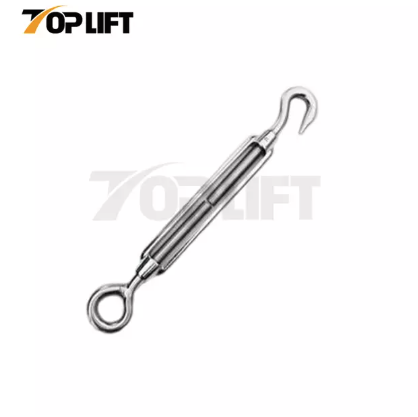
These turnbuckles feature a hook on one side and an eye on the other. They are ideal for applications that require quick detachment or temporary connections, such as in theater rigging or marine applications where adjustments need to be made quickly and efficiently. These designs provide flexibility for tasks that need to be undone frequently.
Jaw and eye or jaw and jaw turnbuckles are used when permanent connections are needed. The jaw end fitting ensures that the rigging remains secure and cannot easily be detached, making them ideal for heavy-duty applications such as suspension bridges or large-scale construction projects. They offer strong, durable connections that can withstand significant load.
Turnbuckles can be made from different materials depending on the environment and load requirements:
Galvanized Steel: This material is often used in general-purpose applications and offers moderate corrosion resistance. It’s ideal for environments where the turnbuckle won’t be exposed to extreme moisture or corrosive substances.
Stainless Steel: This material is highly resistant to rust and corrosion, making it perfect for marine applications or outdoor settings where exposure to water and salt is common. Stainless steel turnbuckles are often preferred when longevity and high performance are required.
Heavy-duty turnbuckles are designed for high-load applications and are often used in large-scale construction projects or industrial settings. These turnbuckles provide maximum stability for structures under high stress. Light-duty turnbuckles, on the other hand, are suitable for applications where only minimal tensioning is required, such as fencing or small-scale recreational uses.
Installing a turnbuckle requires a few straightforward steps:
1. Unscrew the end fittings to their full take-up length.
2. Attach the end fittings to the designated securement points (e.g., shackles or thimbles).
3. Rotate the turnbuckle body to adjust the tension.
4. Tighten the nuts around the body to keep the fittings secure.
Proper installation is essential for ensuring that the turnbuckle functions correctly and maintains the desired tension.
Adhering to the Working Load Limit (WLL) of the turnbuckle is crucial for safe operation. Exceeding the WLL can lead to failure of the turnbuckle or the entire rigging system, resulting in damage or injury. Always ensure that the system is under the recommended load capacity to avoid accidents.
Regular inspection is necessary to ensure the turnbuckle is functioning properly. Look for signs of wear, corrosion, or thread damage. If any of these are present, the turnbuckle should be replaced immediately to prevent failure.
Before removing a turnbuckle, always release tension to avoid sudden slack in the system. Handling the turnbuckle carefully during removal ensures that no damage occurs to the rigging or surrounding components.
Turnbuckles are essential in systems that require exact tensioning. The ability to adjust tension incrementally allows for precise control in critical systems, such as those in suspension bridges, aircraft, and rigging setups. This control is vital in applications where safety and accuracy are paramount.
Turnbuckles are indispensable in multiple industries, from construction to entertainment rigging, due to their ability to provide precise tensioning for a wide variety of applications. This versatility makes them a valuable tool for any rigger or professional working with cables or ropes. Turnbuckles can be adapted to fit various applications, from structural uses to delicate artistic projects.
When made with high-quality materials such as stainless steel, turnbuckles can withstand the challenges of ```
harsh environments. Proper selection and maintenance ensure that turnbuckles remain durable and functional over the long term. Quality turnbuckles provide value and reliability for a wide range of tensioning tasks.
Turnbuckles are simple yet highly effective tools used to adjust tension in various rigging systems. Their versatility and precision make them indispensable in industries such as construction, marine, and entertainment. By choosing the right type of turnbuckle, selecting the appropriate materials, and ensuring proper installation and maintenance, you can maximize performance and reliability. For riggers, turnbuckles from HANGZHOU TOP LIFT INDUSTRIES CO., LTD provide unmatched value, offering superior quality and reliability for all tensioning needs.
A: A turnbuckle is used to adjust the tension in ropes, cables, or other rigging systems. It helps riggers tighten or loosen tension with precise control, making it essential in construction, marine, and entertainment industries.
A: A turnbuckle has opposite threads on each side. When the body is rotated, the end fittings either move apart or come together, adjusting tension in the connected cables or ropes. This allows for quick and accurate tension adjustments.
A: Riggers use turnbuckles to ensure precise tensioning of cables or ropes. This helps maintain stability and safety in various applications, from construction to theater rigging. Turnbuckles allow for fine-tuned control, which is essential for secure and effective rigging.
A: Turnbuckles are typically made from galvanized steel or stainless steel. Stainless steel is ideal for marine and outdoor applications due to its corrosion resistance, while galvanized steel is often used in general-purpose applications where corrosion resistance is less critical.
A: To install a turnbuckle, screw the end fittings into the body, attach them to the rigging points, rotate the body to adjust tension, and tighten the nuts to secure the connection. Make sure the end fittings are correctly aligned to avoid damage.
A: The cost of a turnbuckle depends on its material, size, and load capacity. Stainless steel turnbuckles tend to be more expensive but are more durable for harsh environments. For general purposes, galvanized steel turnbuckles are more cost-effective.
A: Yes, turnbuckles made from stainless steel are perfect for marine applications, where they are used to adjust the tension in sails and rigging on boats and ships. Stainless steel offers superior corrosion resistance, making it ideal for saltwater exposure.
A: Choosing the right turnbuckle depends on factors such as load capacity, material, and application type. For marine applications, stainless steel is recommended, while for general construction purposes, galvanized steel may be sufficient. Always check the working load limit (WLL) to ensure safety.
A: Heavy-duty turnbuckles are designed to handle high loads and are often used in large-scale industrial applications, such as suspension bridges or heavy construction projects. Light-duty turnbuckles, on the other hand, are used for applications with lower tension requirements, such as fencing or small recreational equipment.
A: Yes, turnbuckles are commonly used in theatrical rigging to adjust the tension in ropes and cables used for lighting, backdrops, and other stage equipment. They allow riggers to quickly and precisely adjust the position and tension of elements to ensure the safety and performance of the show.
A: To maintain a turnbuckle, ensure the threads are clean and lubricated, and regularly inspect for signs of corrosion, wear, or damage. If any wear or damage is observed, replace the turnbuckle immediately to ensure the safety of the rigging system.